The Belief That Art Originates in Intuitive Rather Than
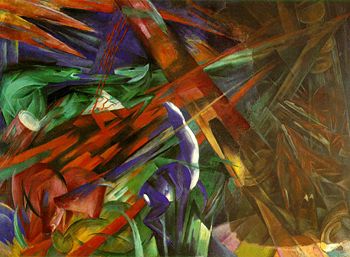
Franz Marc, 1913 "The Fate of the animals."
Modernism, here limited to artful modernism (encounter also modernity), describes a serial of sometimes radical movements in art, compages, photography, music, literature, and the applied arts which emerged in the 3 decades before 1914. Modernism has philosophical antecedents that can be traced to the eighteenth-century Enlightenment just is rooted in the changes in Western society at the terminate of the nineteenth and starting time of the twentieth centuries.
Modernism encompasses the works of artists who rebelled against nineteenth-century bookish and historicist traditions, believing that before aesthetic conventions were becoming outdated. Modernist movements, such as Cubism in the arts, Atonality in music, and Symbolism in poetry, directly and indirectly explored the new economic, social, and political aspects of an emerging fully industrialized earth.
Modernist fine art reflected the deracinated experience of life in which tradition, community, collective identity, and faith were eroding. In the twentieth century, the mechanized mass slaughter of the Outset World War was a watershed event that fueled modernist distrust of reason and further sundered complacent views of the steady moral improvement of human order and belief in progress.
Initially an avant guarde motion confined to an intellectual minority, modernism accomplished mainstream acceptance and exerted a pervasive influence on civilisation and popular entertainment in the form of the twentieth century. The modernist view of truth as a subjective, often intuitive claim has contributed to the peak of individualism and moral relativism as guiding personal ideals and contributed to far-reaching transformations regarding the spiritual significance of human life.
Philosophical and historical background
From the 1870s onward, the ideas that history and culture were inherently progressive and that progress was e'er skillful came nether increasing attack. Arguments arose that non merely were the values of the artist and those of order dissimilar, but that society was antithetical to progress, and could not move forward in its present form. Philosophers called into question the previous optimism.
Two of the about disruptive thinkers of the period were, in biological science, Charles Darwin and, in political science, Karl Marx. Darwin's theory of evolution by natural selection undermined religious certainty and the sense of human being uniqueness, which had far-reaching implications in the arts. The notion that human beings were driven by the aforementioned impulses as "lower animals" proved to be difficult to reconcile with the idea of an ennobling spirituality. Marx seemed to nowadays a political version of the aforementioned proposition: that bug with the economic lodge were not transient, the consequence of specific wrong doers or temporary conditions, simply were fundamentally contradictions within the "capitalist" organization. Naturalism in the visual arts and literature reflected a largely materialist notion of human life and social club.
Separately, in the arts and letters, two ideas originating in France would have item impact. The first was Impressionism, a school of painting that initially focused on work done, not in studios, but outdoors (en plein air). Impressionist paintings demonstrated that human beings do not see objects, merely instead see light, itself. The 2nd schoolhouse was Symbolism, marked by a conventionalities that language is expressly symbolic in its nature, and that poetry and writing should follow connections that the sheer sound and texture of the words create.
At the same fourth dimension, social, political, religious, and economical forces were at piece of work that would become the basis to argue for a radically different kind of art and thinking. In religion, biblical scholars argued that that the biblical writers were not carrying God'due south literal discussion, only were strongly influenced by their times, societies, and audiences. Historians and archaeologists further challenged the factual basis of the Bible and differentiated an evidence-based perspective of the past with the worldview of the ancients, including the biblical authors, who uncritically accepted oral and mythological traditions.
Chief among the physical influences on the evolution of modernism was steam-powered industrialization, which produced buildings that combined fine art and engineering, and in new industrial materials such equally bandage iron to produce bridges and skyscrapers—or the Eiffel Belfry, which broke all previous limitations on how alpine man-made objects could be—resulting in a radically different urban environment.
The possibilities created by scientific examination of subjects, together with the miseries of industrial urban life, brought changes that would shake a European civilization, which had previously regarded itself as having a continuous and progressive line of evolution from the Renaissance. With the telegraph offering instantaneous advice at a distance, the experience of time itself was altered.
The breadth of the changes can be sensed in how many modern disciplines are described equally existence "classical" in their pre-twentieth-century class, including physics, economics, and arts such every bit ballet, theater, or architecture.
The beginning of Modernism: 1890-1910
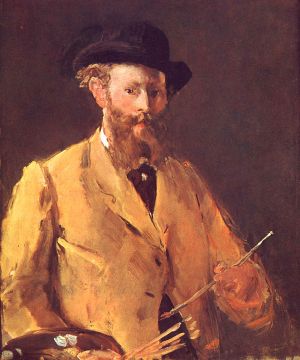
Self-portrait of Edouard Manet
The roots of Modernism emerged in the middle of the nineteenth century; and rather locally, in France, with Charles Baudelaire in literature and Édouard Manet in painting, and perhaps with Gustave Flaubert, too, in prose fiction. (It was a while later, and non so locally, that Modernism appeared in music and architecture). The "avant-garde" was what Modernism was called at offset, and the term remained to describe movements which place themselves as attempting to overthrow some aspect of tradition or the status quo.

In the 1890s, a strand of thinking began to assert that it was necessary to push aside previous norms entirely, instead of just revising past knowledge in light of electric current techniques. The growing move in art paralleled such developments as Einstein's Theory of Relativity in physics; the increasing integration of the internal combustion engine and industrialization; and the increased role of the social sciences in public policy. It was argued that, if the nature of reality itself was in question, and if restrictions which had been in identify around human activity were falling, and so art, too, would have to radically change. Thus, in the first 15 years of the twentieth century a serial of writers, thinkers, and artists made the interruption with traditional means of organizing literature, painting, and music.
Sigmund Freud offered a view of subjective states involving an unconscious mind full of key impulses and counterbalancing self-imposed restrictions, a view that Carl Jung would combine with a belief in natural essence to stipulate a commonage unconscious that was full of basic typologies that the conscious listen fought or embraced. Jung'due south view suggested that people's impulses towards breaking social norms were not the product of childishness or ignorance, but were instead essential to the nature of the human animal, the ideas of Darwin having already introduced the concept of "man, the brute" to the public mind.
Friedrich Nietzsche championed a philosophy in which forces, specifically the 'Will to power', were more important than facts or things. Similarly, the writings of Henri Bergson championed the vital "life force" over static conceptions of reality. What united all these writers was a romantic distrust of the Victorian positivism and certainty. Instead they championed, or, in the case of Freud, attempted to explain, irrational thought processes through the lens of rationality and holism. This was continued with the century-long trend to thinking in terms of holistic ideas, which would include an increased involvement in the occult, and "the vital force."

Composer Arnold Schoenberg
Out of this collision of ideals derived from Romanticism, and an attempt to find a way for noesis to explicate that which was every bit notwithstanding unknown, came the first wave of works, which, while their authors considered them extensions of existing trends in art, bankrupt the implicit contract that artists were the interpreters and representatives of bourgeois culture and ideas. These "modernist" landmarks include Arnold Schoenberg's atonal ending to his Second String Quartet in 1908; the Abstract-Expressionist paintings of Wassily Kandinsky starting in 1903 and culminating with the founding of the Blue Rider group in Munich; and the ascent of Cubism from the work of Picasso and Georges Braque in 1908.
Powerfully influential in this wave of modernity were the theories of Freud, who argued that the mind had a basic and primal structure, and that subjective experience was based on the coaction of the parts of the mind. All subjective reality was based, co-ordinate to Freud's ideas, on the play of basic drives and instincts, through which the exterior world was perceived. This represented a break with the past, in that previously information technology was believed that external and absolute reality could impress itself on an individual, equally, for example, in John Locke'due south tabula rasa doctrine.

This moving ridge of the Modern Movement broke with the past in the start decade of the twentieth century, and tried to redefine various art forms in a radical manner. Leading lights within the literary wing of this trend included Basil Bunting, Jean Cocteau, Joseph Conrad, T. Southward. Eliot, William Faulkner, Max Jacob, James Joyce, Franz Kafka, D. H. Lawrence, Federico García Lorca, Marianne Moore, Ezra Pound, Marcel Proust, Gertrude Stein, Wallace Stevens, Virginia Woolf, and W. B. Yeats amidst others.
Composers such as Schoenberg, Stravinsky, and George Antheil correspond Modernism in music. Artists such as Gustav Klimt, Picasso, Matisse, Mondrian, and the movements Les Fauves, Cubism and the Surrealists stand for diverse strains of Modernism in the visual arts, while architects and designers such as Le Corbusier, Walter Gropius, and Mies van der Rohe brought modernist ideas into everyday urban life. Several figures outside of creative Modernism were influenced past artistic ideas; for example, John Maynard Keynes was friends with Woolf and other writers of the Bloomsbury group.
The explosion of Modernism: 1910-1930

On the eve of World State of war I a growing tension and unease with the social order, seen in the Russian Revolution of 1905 and the agitation of "radical" parties, also manifested itself in artistic works in every medium which radically simplified or rejected previous exercise. In 1913, famed Russian composer Igor Stravinsky, working for Sergei Diaghilev and the Ballets Russes, composed Rite of Spring for a ballet, choreographed by Vaslav Nijinsky that depicted human sacrifice, and young painters such as Pablo Picasso and Henri Matisse were causing a shock with their rejection of traditional perspective as the means of structuring paintings—a stride that none of the Impressionists, not even Cézanne, had taken.
These developments began to give a new meaning to what was termed 'Modernism'. Information technology embraced disruption, rejecting or moving beyond elementary Realism in literature and art, and rejecting or dramatically altering tonality in music. This prepare Modernists autonomously from nineteenth-century artists, who had tended to believe in "progress." Writers like Dickens and Tolstoy, painters like Turner, and musicians like Brahms were non 'radicals' or 'Bohemians', but were instead valued members of society who produced art that added to society, even if information technology was, at times, critiquing less desirable aspects of information technology. Modernism, while it was still "progressive" increasingly saw traditional forms and traditional social arrangements every bit hindering progress, and therefore the creative person was recast as a revolutionary, overthrowing rather than enlightening.
Futurism exemplifies this tendency. In 1909, F.T. Marinetti'southward outset manifesto was published in the Parisian newspaper Le Figaro; presently after a grouping of painters (Giacomo Balla, Umberto Boccioni, Carlo Carrà, Luigi Russolo, and Gino Severini) co-signed the Futurist Manifesto. Modeled on the famous "Communist Manifesto" of the previous century, such manifestos put forward ideas that were meant to provoke and to assemble followers. Strongly influenced past Bergson and Nietzsche, Futurism was part of the general trend of Modernist rationalization of disruption.
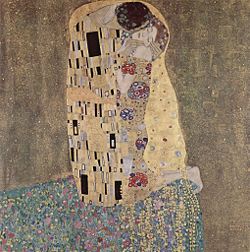
The Kiss, by Gustav Klimt
Modernist philosophy and art were still viewed equally beingness but a part of the larger social move. Artists such as Klimt and Cézanne, and composers such every bit Mahler and Richard Strauss were "the terrible moderns"—other radical avant-garde artists were more heard of than heard. Polemics in favor of geometric or purely abstract painting were largely confined to 'petty magazines' (like The New Age in the United Kingdom) with tiny circulations. Modernist primitivism and pessimism were controversial but were non seen as representative of the Edwardian mainstream, which was more inclined towards a Victorian organized religion in progress and liberal optimism.
However, Earth State of war I and its subsequent events were the cataclysmic upheavals that late nineteenth-century artists such every bit Brahms had worried well-nigh, and avant-gardists had anticipated. Commencement, the failure of the previous condition quo seemed cocky-evident to a generation that had seen millions dice fighting over scraps of earth—prior to the state of war, it had been argued that no one would fight such a war, since the toll was too high. 2d, the birth of a machine age changed the conditions of life—machine warfare became a touchstone of the ultimate reality. Finally, the immensely traumatic nature of the experience dashed basic assumptions: Realism seemed to be bankrupt when faced with the fundamentally fantastic nature of trench warfare, every bit exemplified past books such equally Erich Maria Remarque's All Quiet on the Western Front end. Moreover, the view that mankind was making wearisome and steady moral progress came to seem ridiculous in the face of the senseless slaughter of the Keen War. The Start Earth State of war at once fused the harshly mechanical geometric rationality of technology with the nightmarish irrationality of myth.
Thus in the 1920s, Modernism, which had been a minority sense of taste before the war, came to define the age. Modernism was seen in Europe in such critical movements as Dada, and then in constructive movements such as Surrealism, as well as in smaller movements of the Bloomsbury Group. Each of these "modernisms," as some observers labeled them at the time, stressed new methods to produce new results. Again, Impressionism was a forerunner: breaking with the thought of national schools, artists and writers and adopting ideas of international movements. Surrealism, Cubism, Bauhaus, and Leninism are all examples of movements that apace establish adherents far beyond their original geographic base of operations.
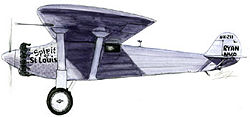
Analogy of the Spirit of St. Louis
Exhibitions, theater, movie theatre, books, and buildings all served to cement in the public view the perception that the world was changing. Hostile reaction often followed, as paintings were spat upon, riots organized at the opening of works, and political figures denounced modernism as unwholesome and immoral. At the same time, the 1920s were known as the "Jazz Age," and the public showed considerable enthusiasm for cars, air travel, the phone, and other technological advances.
Past 1930, Modernism had won a place in the establishment, including the political and artistic institution, although by this fourth dimension Modernism itself had changed. At that place was a general reaction in the 1920s against the pre-1918 Modernism, which emphasized its continuity with a past while rebelling against it, and against the aspects of that flow which seemed excessively mannered, irrational, and emotional. The postal service-Earth-War period, at kickoff, veered either to systematization or nihilism and had, as perhaps its most paradigmatic movement, Dada.
While some writers attacked the madness of the new Modernism, others described information technology as soulless and mechanistic. Amid Modernists at that place were disputes about the importance of the public, the relationship of fine art to audience, and the role of art in society. Modernism comprised a series of sometimes-contradictory responses to the situation as information technology was understood, and the attempt to wrestle universal principles from information technology. In the terminate science and scientific rationality, oftentimes taking models from the eighteenth century Enlightenment, came to be seen as the source of logic and stability, while the bones primitive sexual and unconscious drives, along with the seemingly counter-intuitive workings of the new auto age, were taken as the basic emotional substance. From these two poles, no matter how seemingly incompatible, Modernists began to way a complete worldview that could embrace every attribute of life, and express "everything from a scream to a chuckle."
Modernism's second generation: 1930-1945
By 1930, Modernism had entered popular civilisation. With the increasing urbanization of populations, it was beginning to be looked to equally the source for ideas to deal with the challenges of the day. Every bit Modernism gained traction in academia, it was developing a self-witting theory of its own importance. Popular culture, which was not derived from loftier civilization but instead from its own realities (specially mass production), fueled much Modernist innovation. Modern ideas in art appeared in commercials and logos, the famous London Undercover logo being an early example of the need for clear, hands recognizable and memorable visual symbols.
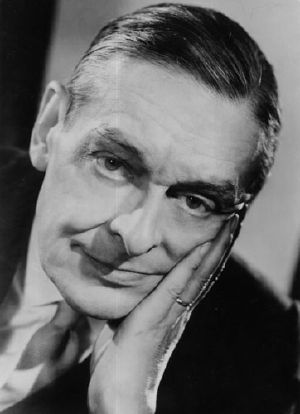
Some other potent influence at this time was Marxism. After the by and large primitivistic/irrationalist attribute of pre-Earth-State of war-One Modernism, which for many Modernists precluded any attachment to merely political solutions, and the Neo-Classicism of the 1920s, as represented most famously past T. Southward. Eliot and Igor Stravinsky—which rejected pop solutions to mod problems—the rise of Fascism, the Great Low, and the march to war helped to radicalize a generation. The Russian Revolution was the catalyst to fuse political radicalism and utopianism with more than expressly political stances. Bertolt Brecht, Due west. H. Auden, Andre Breton, Louis Aragon, and the philosophers Gramsci and Walter Benjamin are peradventure the most famous exemplars of this Modernist Marxism. This movement to the radical left, however, was neither universal nor definitional, and at that place is no particular reason to associate Modernism, fundamentally, with 'the left'. Modernists explicitly of "the correct" include Wyndham Lewis, William Butler Yeats, T. Southward. Eliot, Ezra Pound, the Dutch author Menno ter Braak, and many others.
One of the nearly visible changes of this flow is the adoption of objects of modern production into daily life. Electricity, the telephone, the automobile—and the demand to piece of work with them, repair them, and live with them—created the need for new forms of manners, and social life. The kind of confusing moment which only a few knew in the 1880s became a common occurrence every bit telecommunication became increasingly ubiquitous. The speed of communication reserved for the stockbrokers of 1890 became part of family unit life.
Modernism in social arrangement would produce inquiries into sex and the basic bondings of the nuclear, rather than extended, family. The Freudian tensions of infantile sexuality and the raising of children became more intense, considering people had fewer children, and therefore a more specific relationship with each child: the theoretical, once again, became the practical and fifty-fifty pop. In the arts besides as popular civilisation sexuality lost its mooring to marriage and family and increasingly came to be regarded equally a self-oriented biological imperative. Explicit depictions of sex in literature, theater, film, and other visual arts often denigrated traditional or religious conceptions of sex and the implicit human relationship between sex activity and procreation.
Modernism's goals
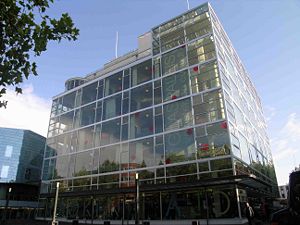
The 'Drinking glass Palace' (1935) in the Netherlands - functional and open
Many modernists believed that by rejecting tradition they could detect radically new ways of making fine art. Arnold Schoenberg believed that by rejecting traditional tonal harmony, the hierarchical system of organizing works of music which had guided music-making for at least a century and a half, and perhaps longer, he had discovered a wholly new way of organizing sound, based on the utilise of 12-note rows. This led to what is known as series music past the postal service-state of war period.
Abstract artists, taking equally their examples from the Impressionists, too as Paul Cézanne and Edvard Munch, began with the supposition that color and shape formed the essential characteristics of art, not the depiction of the natural world. Wassily Kandinsky, Piet Mondrian, and Kazimir Malevich all believed in redefining art as the arrangement of pure color. The use of photography, which had rendered much of the representational part of visual art obsolete, strongly afflicted this aspect of Modernism. Nonetheless, these artists also believed that by rejecting the delineation of textile objects they helped art move from a materialist to a spiritualist phase of development.
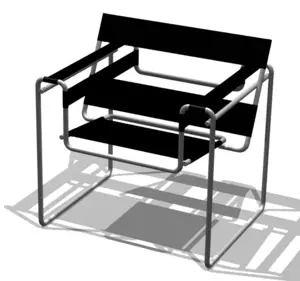
Other Modernists, particularly those involved in design, had more than pragmatic views. Modernist architects and designers believed that new engineering rendered erstwhile styles of edifice obsolete. Le Corbusier thought that buildings should function as "machines for living in," coordinating to cars, which he saw equally machines for traveling in. Just as cars had replaced the equus caballus, and then Modernist design should reject the erstwhile styles and structures inherited from Ancient Greece or from the Middle Ages. Following this automobile artful, Modernist designers typically refuse decorative motifs in pattern, preferring to emphasize the materials used and pure geometrical forms. The skyscraper, such as Ludwig Mies van der Rohe'southward Seagram Edifice in New York (1956–1958), became the archetypal Modernist building.
Modernist design of houses and piece of furniture also typically emphasized simplicity and clarity of form, open-plan interiors, and the absenteeism of clutter. Modernism reversed the nineteenth-century human relationship of public and private: in the nineteenth century, public buildings were horizontally expansive for a variety of technical reasons, and private buildings emphasized verticality—to fit more private infinite on more and more limited state.
In other arts, such pragmatic considerations were less important. In literature and visual fine art, some Modernists sought to defy expectations mainly in order to make their art more vivid, or to force the audition to take the problem to question their own preconceptions. This attribute of Modernism has often seemed a reaction to consumer culture, which adult in Europe and Northward America in the late-nineteenth century. Whereas most manufacturers effort to make products that will exist marketable by appealing to preferences and prejudices, High Modernists rejected such consumerist attitudes in order to undermine conventional thinking.
Many Modernists saw themselves as apolitical. Others, such equally T. S. Eliot, rejected mass popular culture from a bourgeois position. Indeed, ane could argue that Modernism in literature and art functioned to sustain an elite culture which excluded the majority of the population.
Modernism'south reception and controversy
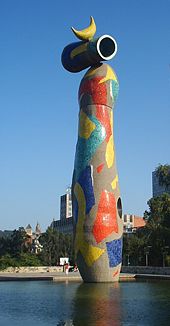
Ceramic Sculpture by Joan Miró
The nigh controversial attribute of the Modernistic motion was, and remains, its rejection of tradition. Modernism's stress on liberty of expression, experimentation, radicalism, and primitivism disregards conventional expectations. In many fine art forms this often meant startling and alienating audiences with baroque and unpredictable effects: the foreign and disturbing combinations of motifs in Surrealism, the apply of extreme dissonance and atonality in Modernist music, and depictions of nonconventional sexuality in many media. In literature Modernism oftentimes involved the rejection of intelligible plots or characterization in novels, or the creation of poetry that defied clear interpretation.
The Soviet Communist government rejected Modernism after the rise of Stalin on the grounds of alleged elitism, although it had previously endorsed Futurism and Constructivism; and the Nazi government in Germany deemed it narcissistic and nonsensical, as well equally "Jewish" and "Negro." The Nazis exhibited Modernist paintings alongside works past the mentally ill in an exhibition entitled Degenerate art.
Modernism flourished mainly in consumer/backer societies, despite the fact that its proponents often rejected consumerism itself. However, High Modernism began to merge with consumer culture subsequently World War II, especially during the 1960s. In Britain, a youth sub-culture even called itself "moderns," though usually shortened to Mods, post-obit such representative music groups equally The Who and The Kinks. Bob Dylan, The Rolling Stones, and Pink Floyd combined popular musical traditions with Modernist verse, adopting literary devices derived from Eliot, Apollinaire, and others. The Beatles adult along similar lines, creating various Modernist musical furnishings on several albums, while musicians such as Frank Zappa, Syd Barrett, and Captain Beefheart proved even more experimental. Modernist devices too started to announced in popular cinema, and later on in music videos. Modernist design also began to enter the mainstream of popular culture, equally simplified and stylized forms became pop, oftentimes associated with dreams of a space age high-tech futurity.
This merging of consumer and high versions of Modernist culture led to a radical transformation of the pregnant of "modernism." Firstly, it implied that a movement based on the rejection of tradition had become a tradition of its own. Secondly, it demonstrated that the distinction betwixt aristocracy Modernist and mass-consumerist civilisation had lost its precision. Some writers declared that Modernism had become and so institutionalized that it was at present "postal service avant-garde," indicating that it had lost its power every bit a revolutionary motion. Many take interpreted this transformation as the beginning of the phase that became known as Mail service-Modernism. For others, such as, for instance, art critic Robert Hughes, Mail-Modernism represents an extension of Modernism.
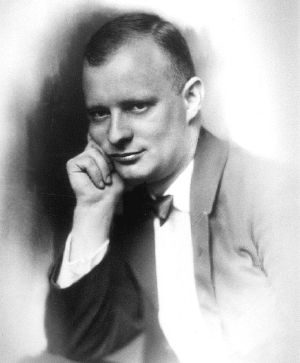
"Anti-Mod" or "counter-Modern" movements seek to emphasize holism, connectedness, and spirituality as being remedies or antidotes to Modernism. Such movements run into Modernism as reductionist, and therefore subject to the failure to see systemic and emergent effects. Many Modernists came to this viewpoint; for case, Paul Hindemith in his late plow towards mysticism. Writers such equally Paul H. Ray and Sherry Ruth Anderson, in The Cultural Creatives, Fredrick Turner in A Culture of Hope, and Lester Brownish in Plan B, have articulated a critique of the basic idea of Modernism itself—that individual creative expression should arrange to the realities of applied science. Instead, they argue, private creativity should make everyday life more emotionally acceptable.
In some fields, the furnishings of Modernism have remained stronger and more persistent than in others. Visual fine art has made the most complete break with its past. Virtually major capital cities take museums devoted to 'Modern Art' every bit singled-out from post-Renaissance art (circa 1400 to circa 1900). Examples include the Museum of Modernistic Art in New York, the Tate Modern in London, and the Centre Pompidou in Paris. These galleries make no distinction betwixt Modernist and Post-Modernist phases, seeing both every bit developments within 'Modern Art.'
References
ISBN links support NWE through referral fees
- Bradbury, Malcolm, and James McFarlane (eds.). Modernism: A Guide to European Literature 1890–1930. Penguin, 1978. ISBN 0140138323
- Hughes, Robert. The Shock of the New: Art and the Century of Modify. Gardners Books, 1991. ISBN 0500275823
- Levenson, Michael (ed.). The Cambridge Companion to Modernism. Cambridge Academy Press, 1999. ISBN 052149866X
- Pevsner, Nikolaus. Pioneers of Modernistic Design: From William Morris to Walter Gropius. Yale University Press, 2005. ISBN 0300105711
- Pevsner, Nikolaus. The Sources of Modernistic Architecture and Design, Thames & Hudson, 1985. ISBN 0500200726
- Weston, Richard. Modernism. Phaidon Press, 2001. ISBN 0714840998
Credits
New Earth Encyclopedia writers and editors rewrote and completed the Wikipedia article in accordance with New World Encyclopedia standards. This commodity abides past terms of the Creative Commons CC-past-sa 3.0 License (CC-by-sa), which may be used and disseminated with proper attribution. Credit is due under the terms of this license that can reference both the New Earth Encyclopedia contributors and the selfless volunteer contributors of the Wikimedia Foundation. To cite this commodity click hither for a list of acceptable citing formats.The history of earlier contributions by wikipedians is accessible to researchers here:
- Modernism history
The history of this commodity since information technology was imported to New World Encyclopedia:
- History of "Modernism"
Notation: Some restrictions may apply to use of individual images which are separately licensed.
Source: https://www.newworldencyclopedia.org/entry/modernism
0 Response to "The Belief That Art Originates in Intuitive Rather Than"
Post a Comment